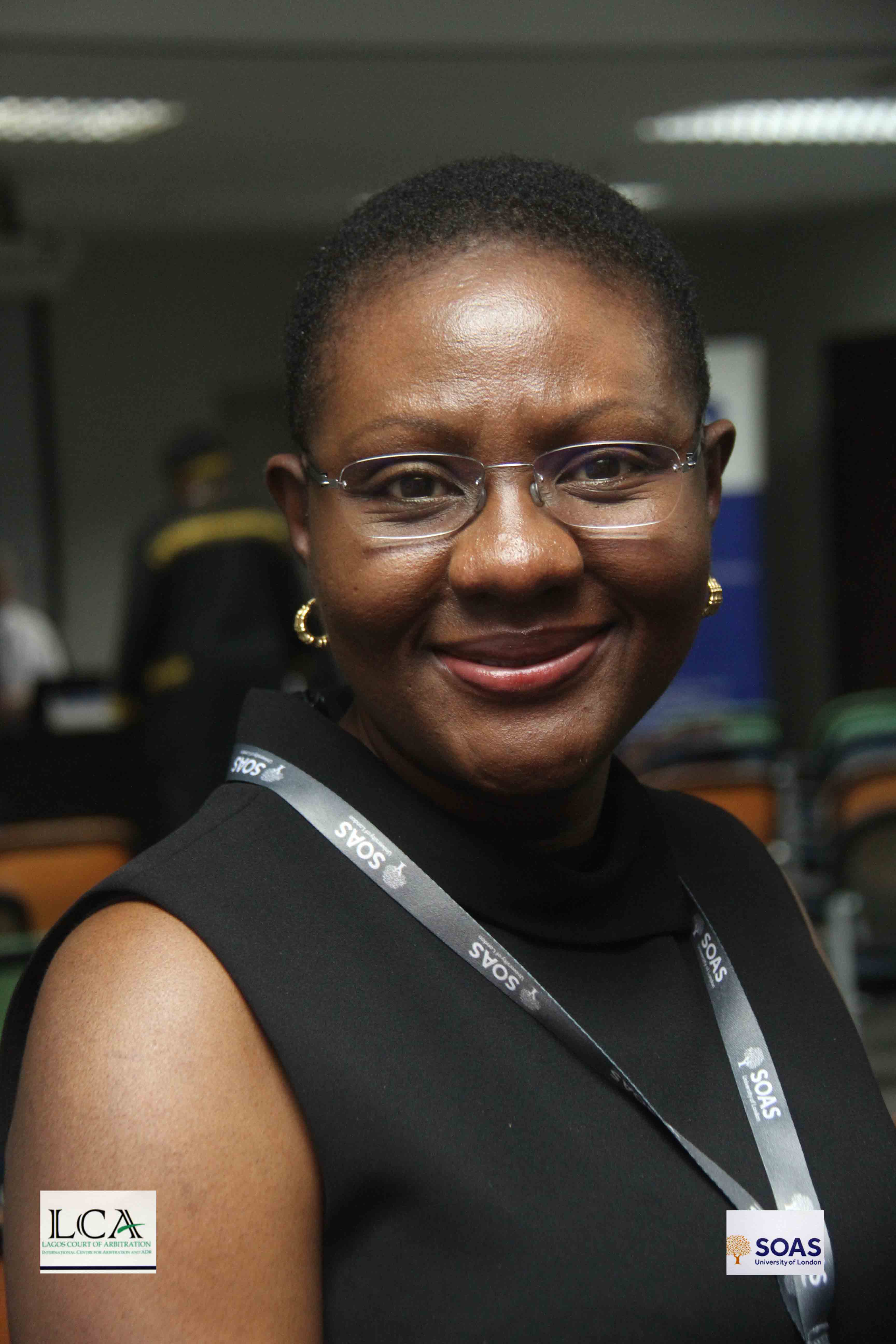
Name of arbitrator:
Dr Emilia Onyema
Education, awards and selected publications:
Education:
- PhD in International Commercial Arbitration: Queen Mary University of London: 2002-2007
- LLM (Commercial and Corporate Law): King’s College London, 2000-2001
- LLB (Hons): University of Jos, Nigeria: 1984-1988
- Fellow, Chartered Institute of Arbitrators: October 2008
- Barrister & Solicitor, Supreme Court of Nigeria: August 1989
- Solicitor, England & Wales (non-practising): 2002
Selected publications:
- Emilia Onyema (ed), Rethinking the Role of African National Courts in Arbitration, Kluwer Law International, Kluwer Law International, 2018.
- Emilia Onyema (ed), The Transformation of Arbitration in Africa: The Role of Arbitral Institutions, Kluwer Law International, 2016.
- Emilia Onyema, International Commercial Arbitration and the Arbitrator’s Contract, Routledge Cavendish, 2010.
- Emilia Onyema, “African Participation in the ICSID System: Appointment and Disqualification of Arbitrators”, ICSID Review – Foreign Investment Law Journal (2019) pp 1-23.
- Emilia Onyema, “Reimagining the Framework for resolving Intra-African Commercial Disputes in the Context of the African Continental Free Trade Area Agreement”, World Trade Review (2019) pp 1-25.
- “Regional Arbitration Institution for ECOWAS: Lessons from OHADA Common Court of Justice and Arbitration” (2014) Int’l ALR Vol 17 Issue 5, pp 99-111.
- Emilia Onyema, “Shifts in Dispute Resolution Processes of West African States” in Moscati A, Roberts M, & Palmer M (eds) Comparative Dispute Resolution Handbook (Edward Elgar Publishing, forthcoming 2019).
- Emilia Onyema, “The Jurisdictional Tensions Between Domestic Courts and Arbitral Tribunals” in Menaker, Andrea (ed) International Arbitration and the Rule of Law: Contribution and Conformity, ICCA Congress Series No 19, Kluwer (2017) pp 481-500
Countries qualified to practice:
- Nigeria
- England and Wales (non-practising solicitor)
Language(s):
English
Name of law firm or institution:
SOAS University of London
Area(s) of specialisation:
International commercial contracts; shareholder’s agreements; real estate purchase agreements; international sale of goods; partnership agreements; international investment agreements.
Institutional affiliation(s):
- President, Council of Advisers, Libyan Centre for International Commercial Arbitration from 2018.
- Member, Advisory Committee, Cairo Regional Centre for International Commercial Arbitration (CRCICA) from 2017.
- Arbitration Court Member, Lagos Chamber of Commerce International Arbitration Centre, since 2015.
- Member, Arbitration Court of the Lagos Court of Arbitration Centre, since 2019.
- On Arbitrator Panel: Abu Dhabi Commercial Conciliation Arbitration Centre, since 2017.
- On Arbitrator Panel: Kigali International Arbitration Centre, since 2016.
- On Arbitrator Panel: Kuala Lumpur IAC Panel from 2015.
- On Arbitrator Panel: Dubai IAC Panel from 2015.
Professional Memberships
- Barrister and Solicitor of the Supreme Court of Nigeria, August 1989
- Member, International Bar Association since 1996
- Chartered Institute of Arbitrators London since 1999 (as a fellow since 2009)
- Law Society, England & Wales since 2002 (as non-practising solicitor)
- Society of Legal Scholars since October 2006
- Member, Arbitral Women.
- Member, London Court of International Arbitration since 2008
- Senior Fellow of the Higher Education Academy, since 2018.
- Academic member, International Council for Commercial Arbitration (ICCA) from 2015.
- Pan African Lawyers Union (Life member)
Do you think arbitration institutions in Africa are suitably equipped to administer international arbitration disputes?
Yes I do. From our (being SOAS University of London) research, there are at least 75 known arbitral centres operating in various African states. However, a handful are very well known: the AALCO regional centres in Cairo, Lagos and Nairobi; the Kigali International Arbitration Centre; MARC in Mauritius; Ghana Arbitration Centre, CMAC in Casablanca; AFSA in South Africa, the OHADA, CCJA, and GICAM. These well-known centres are located in different regions of the continent and in my opinion, can act as regional specialists to drive the growth of institutional arbitration in their respective regions. The development of the centres/institutions remains work-in-progress. As they administer more disputes of varying degrees of complexity, they will hone their skills and provide better service to their users.
From your latest book published by Kluwer Wolters- titled ‘Rethinking the Role of African National Courts in Arbitration’, how would you rate the judicial support for arbitration in Africa? How effective is the support?
Since Africa is a continent of 54 independent states with different levels of development and legal systems, it is difficult to lump all the states together for rating purposes. There are some states (e.g. South Africa, Rwanda, Mauritius, Kenya, and the OHADA CCJA) whose judiciaries actively pursue a supportive regime for arbitration. The reasons for such support differ with each state. There are quite a number of states whose judiciaries provide mixed signals (e.g. Nigeria, Egypt, and Ghana). In my opinion, there is no jurisdiction in Africa whose judiciary is outrightly hostile towards arbitration as a dispute resolution mechanism (not even Tanzania for now). The primary need is for these judiciaries to adjudicate on many more arbitration related cases, to build the relevant jurisprudence that will enable us make this assessment on the basis of evidence.
As it relates to effectiveness, the same variation applies. But generally, the higher courts (court of appeals and supreme courts) are very supportive. In some of the states, the first instance courts need to better understand the nature of arbitration and its relationship with litigation/the judiciary. For now, a litigant needs to be willing to appeal to higher courts of record which have both time and cost impacts on the parties and their disputes.
With more African states acceding to the New York Convention, what are your thoughts on the enforcement trends in Africa?
Accession to the NYC does not mean the judiciary in a State will change overnight. There needs to be continued sharing of knowledge (e.g. ICCA New York Convention Roadshows; the New York Convention website and the UNCITRAL case-law database) with the judiciaries in these States so they are kept abreast of developments in the interpretation by other judiciaries of the provisions of the NYC. We also need access to decisions made by courts in Africa states to be publicly available and easily accessible. It is my expectation that such sharing of knowledge/information will enhance the quality of decision making coming out of courts in Africa.
What advice do you have for young practitioners who see you as their role model?
First, it is an honour (and burden, in a positive sense) for me to be seen as a role model. My advice will be for each of us (including myself) to excel in our job and continue to pursue excellence in all we do. Integrity is highly priced in our profession and rightly so. I know we have all heard this before but it is true that arbitration is not a sprint but a marathon, so be patient and when you get that first opportunity to act as counsel, tribunal secretary, administrator, arbitrator, or expert, do an excellent job. Your work will speak for you and you will get more instructions. Finally, enjoy life!
How can arbitration in Africa be improved?
There are different facets to improving arbitration in Africa. We are all contributing to its improvement by the work the AYA is doing (e.g. your arbitration academy for young practitioners; the moots; conferences; workshops, etc); the research and conferences we (at SOAS University of London) organize; the various conferences creating meeting spaces for arbitration enthusiasts and practitioners to meet and learn from each other; the publication of Africa related arbitration news and information by I-Arb; the creation of the umbrella organization (African Arbitration Association), to name a few, will all enhance the development and growth of arbitration in Africa.